Showing posts with label Clement Greenberg. Show all posts
Thursday, June 7, 2012
Star Wars & Modernism: Episode IV - The Hope of the NEW
Below are the slides for the first of a three-part, "8-bit", art history lecture on Star Wars and American Cold War Modernism I gave via Twitter. (Return to Introduction for more explanation.) I have added text to this episode to introduce some of the charicters and texts that are referenced in the "slides."
Tuesday, November 8, 2011
For Those in the NYC area:
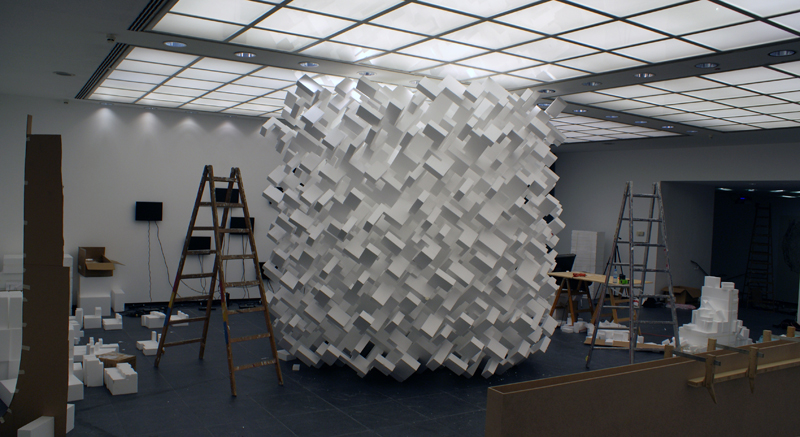
Clement Greenberg as a Sith; installation view of Make/Believe and Benthic Empire
I am going to be giving a talk on Star Wars and Minimalism this Thursday, November 10th, as part of Performa 11th. For those interested in talking about how awesome and exciting Postwar art and Cold War politics are, as well as picking apart the visual program of the original 1977 Star Wars film, this talk is for you: STAR WARS AND THE RHETORIC OF POWER
Meanwhile I also have two works up as part of a group show called "Full Fathom Five" at the Jenkins Johnson Gallery on West 26th, that is open through December 23rd. I share Jerry Saltz's impatience with the "endless stream of art-school-trained artists trying to crawl up the asses of Andy Warhol, Richard Prince, and Gerhard Richter in order to stake out a microscopic piece of insular, already-approved territory." For myself I enjoy inhabiting the colons of Jay DeFeo, Robert Morris and Robert Smithson. If my art looks like something out of scifi, it is because I believe abstract art is an arm of futurism - additionally I like art that gives the impression that it can defend itself.
Monday, July 11, 2011
White Walls, The Gold Standard (Part 10)
(Part 9)
William Gibson has observed that "The future is already here – it's just not evenly distributed." And indeed, high-technology can be mapped out as the very uneven distribution of urban light seen on the earth's night side, as the overlap of high pollution emissions and GDP, or as telecommunication traffic. All are expressions of modern wealth. Those of us who live in the brightly lit, heavily trafficked spots on the map enjoy a greater portion of the future, but still bear a full portion of the past. If he were still alive to answer Gibson, William Faulkner might have said that the past is very evenly distributed. To understand what hi-tech whiteness means, it is crucial to see not only that it is a prestige color. Like the conspicuous consumption of lighting the night sky, whiteness is a marker of wealth. Blackness is not its opposite number however; the two are equivalents. An actual alternative; a true foil, is one that belongs as completely to the past as whiteness belongs to the future: gold.
Thursday, May 5, 2011
Art Then Technology (Part 8): Modernism Is Not Modernity
Fat Bastard: end of sixth day of installation (2010).
(Return to Part 7.5)
In his book, What Technology Wants, Kevin Kelly explains that a very common error made with almost all new technologies is "to imagine the new thing doing an old job better." The old, premodern, job of art, as an expression of top down authority, was misattributed to modernity by the Modernists.
Monday, May 2, 2011
Art Then Technology (Part7.5): Medium is not the Message
US Dollar; Johannes Adam Simon Oertel, Pulling Down the Statue of King George III, (1859)
(Return to Part 7)
(Return to Part 7)
Tuesday, March 22, 2011
Middle Modernism
Jane Jacobs is the Mother of all Jedi (and yes Gladwell is one of the Skywalker twins)
The medieval European doctrine, "City air makes free," is quoted by Jane Jacobs in her book Economy of Cities, more recently in Stewart Brand's Whole earth Discipline, and in Steven Johnson's latest book Where Good Ideas Come From. This isn't just a coincidence. Jacobs is the mother of New Urbanism; Brand and Johnson are both diehard urbanists and admirers of Jacobs. But Jacobs is also the God mother of a new strain of Modernism that Brand and Johnson are examples of. Jacobs cites Brand in her last book, Dark Ages Ahead. (Not her best book, but still how cool would that be?) Jacobs was writing in response to Jared Diamond's Guns, Germs and Steel (even cooler), where he made his case for a "genuine science of human history." Kevin Kelly who co-curates the Long Now seminars with Brand and did a Book tour with Johnson late last Year is another new Modernist, I would add to the list Gail Collins, Malcolm Gladwell, David Bell, Helen Fisher... the list goes on. These are not the sorts of writers that are cited in academic papers, these are the sorts of thinkers one finds searching airport book stores or giving TED talks.
Friday, February 25, 2011
Watching the Watchmen
Charlie Sheen in Two and A Half Men: The crowd watching Christian Marclay's Clock.
I have written on the subject of criticism and popularity before, so when I got in a short dust up with Tyler Green on Twitter, I was going to let the subject drop - but I am like a dog with a bone. If you follow this LINK you will find a cut and paste of Tyler Green’s recent review of Christian Marclay’s The Clock with a few edits. It was assembled by Steve Mesler who usually blogs about making art for Huffington Post. Steve sent me this after my short back and forth with Green. Steve, who is in Savana interviewing Marina Abramovic today, took the “Find and Replace” function in google documents, replacing Christian’s name for Abramovic's and The Clock for The Artist is Present. Add in a couple of liberties with the narrative and what you have is a review for any popular show the art world has ever, or might ever mount. I asked Steve if I could link to his joke because it shows exactly why I found Green's review so disappointing. In a review of what I felt was a complex piece of durational art, about time, Green chose to write a formulaic review complaining against formula. Green Accused Marclay of being tired, but used the most tired of all art world cliches: he chose to sneer at the crowds of us gullible to want to see the work at all.
Monday, December 27, 2010
Art Then Technology (Part 5): Abstract Art Is A Technology.
As a participant in an exhibition of abstract 'generative' art called abstrakt - Abstrakt, I spent nine days installing, and had a lot of time to think about the work of the other artists in the show, most of whom used or addressed the crumbling edge of digital technology, and almost all of whom evoked for me the flatfooted logic of the last great wave of abstract art, 1960s era minimalism. My work is sometimes describes as post-minimalist. I like to describe it as post-Star Wars-minimalism, but not because it's high-tech. My art is not-at-all-crumbling edge; I use no advanced technology, my design and fabrication is entirely analog, but by the time I became aware of abstraction, Modernism had been recast as the Deathstar and destroyed. Abstract artist of my generation are "late-adopters." Late adopter is a term usually reserved for technologies. My decision to take up abstraction in the mid-1990s was because abstraction is not a style, that the difference between abstract art and earlier art is not a difference in quality, it is a difference in kind. But it has only been as I've been thinking about exactly what technology is that it occurred to me that the difference is the difference between a very old technology and a relatively new one.
Labels:
Allan Kaprow,
Art,
Beuys,
Clement Greenberg,
Foucault,
Kandinsky,
Kevin Kelly,
Lyotard,
Marcel Duchamp,
Mondrian,
Neocons,
Paul McCarthy,
postmodernism,
Robert Morris,
Smithson,
Stewart Brand,
technology,
Then Technology,
Tom Jay
Monday, July 26, 2010
Star Wars Highbrow: Thesis Antithesis Synthesis
Joshua Glenn's final revision of my Star Wars Klein group diagram
Above is another variant on my Star Wars Klein Group Diagram. I heard from HiLoBrow.com's Joshua Glenn. turns out the first version of his Star Wars Semiotic Square I posted was pretty close to the mark, but I got some things mixed up. I left that first version up but guided by his corrections here is the final "fully functional" Joshua Glenn Star Wars Semiotic Square.
In addition to describing the square above Glenn's original post also discussed his choices for the cardinal points at some length in terms of a "highbrow-lowbrow-middlebrow-nobrow-hilobrow schema." It is a scheme he has charted elsewhere, admitting that "aesthetic and lifestyle choices aren't entirely independent of social class." Until I read Glenn's criticism it hadn't consciously occurred to me to think about lowbrow vs highbrow in any systematic way. I suppose if I thought about it at all, I figured that what I have been doing with my Star Wars & Modernism project is some sort of highbrow take on a lowbrow film, or a lowbrow take on highbrow art and architecture. In his post however Glenn calls Star Wars "George Lucas’ attempt to cobble together a middlebrow entertainment following Joseph Campbell’s template" and calls Lucas himself a sentimental middlebrow. Once he brought it to my attention, it made perfect sense, lowbrow is not the term of derision, middlebrow is. Posting on the middlebrow (Farting in Church) wet my appetite. The term turns out to be so loaded with connotations, not just of social class, but ideas about cultural and racial superiority left over from the waning years of the age of imperialism, and Star Wars is the perfect vehicle to unpack the biases shadowing the judgement of both high and low.
A diagram I made according to Joshua Glenn "highbrow-lowbrow-middlebrow-nobrow-hilobrow schema."
Labels:
Anna Chave,
architecture,
Avatar,
Bauhaus,
Clement Greenberg,
Design,
Edward Said,
feminism,
Joshua Glenn,
joyce kozloff,
Kozloff,
middlebrow,
Semiotic Square,
Star Wars,
urbanism,
Valerie Jaudon
Thursday, July 22, 2010
Farting in Church: Charting the Middlebrow
Dante Alighieri, Robert Morris, Venti III (1983)
Anyone who has ever attempted to read Dante's Divine Comedy knows all the fun stuff is in the first book - The Inferno. Hell as turns is hilarious, full of sex, lies, farting and the most cruelly scatological punishments imaginable (as I remember there was a lot more bathroom humor than blood spatter) I battered my way through the holier-than-thou geographies of Purgatory, but was stopped cold by the the totally ponderous descriptions of Paradise.
If the Modernist had designed the universe (that finally was their goal), Paradise would be just as ponderous, but the ranks of singing angels (or whatever, I really didn't read much of that book at all) would be replaced by the clean utilitarian lines that Mies van der Rohe championed as less is more and Robert Venturi mocked as 'less is a bore.'
Friday, July 16, 2010
The Killing Fields (Part 3/4): Killing Rosalind Krauss
Death and the Maiden: Rosalind Krauss, Ingmar Bergman,s The Seventh Seal, Clement Greenberg
The reason Clement Greenberg was inconsistent on the subject of sculpture is because in constructing his formalist theories he had conceptually painted himself into a corner. He insisted that the ideas in Modernist Painting were never intended to be prescriptive, but he had successfully mapped a generation worth of artistic production, starting with Frank Stella's black painting (which he evidently didn't much like), right up through to the minimalist (who he down right disliked), and dribbling out among the earth artists (those guys were totally formalists - see PMD 2/3). That is no small achievement, even accounting for the mixed results (in Greenberg's opinion). His rejection of minimalism wasn't arbitrary - he clearly hoped to extend his influence for another decade or two.
Tuesday, July 13, 2010
The Killing Fields (Part 2/4): Killing Clement Greenberg
Just as artists had "entered a situation the logical conditions of which can no longer be described as modernist," some time in the late sixties and early seventies, so too had Rosalind Krauss. her Klein group diagram elegantly signaled two things: that she was orienting her thought by means of the "undecidable" mix of intellectual disciplines that was just beginning to coalesce at the time; but more importantly, the diagram was a visual rebuttal to the modernist theoretical framework that had dominated the New York art world for decades. Like the cartoonist Thomas Nast lampooning Boss Tweed, Krauss constructed a visual tool that her constituents could easily understand, but Krauss's target was the modernist critic Clement Greenberg. Like Tweed, Greenberg might have yelped, "Let's stop them damned pictures, I don't care so much what the papers write about—my constituents can't read—but damn it, they can see pictures." In all probability however, Greenberg may have never understood that his most important constituents were artists, or how effective Krauss's diagram would turn out to be in undoing his legacy.
Monday, July 12, 2010
The Killing Fields (Part 1/4): Killing Modernism
Anne Truitt, Southern Elegy (1964), Rosalind Krauss, Incomplete Klein Group Diagram (1979)
At the Sculpture Center’s panel, Expanded. Exploded, Collapsed? held this past April in celebration of the 31st anniversary of Rosalind Krauss's essay Sculpture in the Expanded Field (I did not ask, but one wonders what they will do for the 53rd jubilee), the sculptor Josiah McElheny playfully quoted some anonymous snark (almost certainly Michael Fried) as saying, “We all just discovered Klein groups at the time, we thought the essay was just to show she knew how to use them.” Never mind how dismissive this is of Krauss’s intellect; it ignores how effective Krauss’s use of the Kline group diagram was. The curator Fionn Meade's introduction to the panel focused on what was left out of the the Field (civil rights as monument, the Judson Group as sculpture, Joseph Beuys as persona non grata) but made clear that even thirty years later the Expanded Field, no matter how imperfect, remains a "hinge" between the modern and postmodern. Krauss's diagram of the Expanded Field was machine built to kill and bury Modernism:
Tuesday, July 6, 2010
Painting Must Die (Part 1/3): Backing into Murder
Frank Stella, Hyena Stomp (1962), Robert Smithson, Spiral Jetty (1970)
Barnet Newman's quip that, "sculpture is what you bump into when you back up to see a painting,” has become a cliche no self respecting art historian would quote. So it's a curious pleasure to find it in Rosalind Krauss's essay, Sculpture in the Expanded Field. (It's like coming across a knock knock joke in a Walter Benjamin essay.) Like all humor, Newman's joke is funny because it is a little cruel, and it is cruel because there's some truth to it (one of my pieces was damaged that way once - my friends all laughed). As a sculptor it is painful to admit this, but by all accounts, for most of history, painting has driven art. That’s why we discuss the death of painting, and (almost) never the death of sculpture. The harsh truth is, no one much cares if sculpture dies because sculpture is thought of as a kind of painting; a parasitic twin carved in stone.
Subscribe to:
Posts (Atom)