Showing posts with label Pruitt-Igoe. Show all posts

Wednesday, November 13, 2013

New Ideas Need Tall Buildings: Gentrification vs Integration - Flying Wedges vs Rooted Anchors

Alfredo Brillembourg presenting Torre David at this year's CTsummit

Last week I wrote a post for ArtFCity titled "A Look at The Creative Time Summit: Gentrification, Gentrification, and Gentrification." I was asked to do something relatively short and straightforward but managed to write myself into a corner, turning the post into something long, difficult, even a little scary. "Gentrification" is an umbrella term that covers a constellation of assumptions and biases - the great majority of which I find wrong-headed and vexing. According to Wikipedia, the term "gentrification" was coined by the British sociologist Ruth Glass in 1964. That it is a derivative of "gentry," itself, clearly signals that ownership was core to its original meaning. It was used by Glass to refer to the threat posed to lower-class worker residents, who depended on public housing, by the then fast-growing middle-class residents who, increasingly, could afford to own housing. Gentrification names a brand of class conflict, not an invasion of a bourgeois horde. But not surprisingly Americans have ever used the word gentrification the way the Brits originally intended. In the US race has always been a stand in for class. So US speakers use "gentrification" as a coded way to say "white people" much the same way they use "urban" as a coded way to speak of "black people." And like all coded language, the term "gentrification" obscures and disguises more than in communicates.

Wednesday, December 7, 2011

Looking at Modernism with David Brin -6

Sith Architecture: Le Corbusier and Star Wars 
(Return to Part 5)
When I originally sent David the link to my essay, Star Wars: A New Heap I knew he was an unlikely fan of my ideas about Star Wars. I understood what he disliked about the film's plot and the franchises influence on the world of scifi publishing. In no way, shape, or form, did I think I would change David's judgment of the movie (or even wanted to). But because he counts himself a contrarian, I hoped he would enjoy the spirit of my project. I was ecstatic when he replied to my email and have enjoyed the polite sparing of our sporadic correspondence ever since. The subject of our sparing hasn't been Star Wars, however, its been modernity and Modernism. David has made it very clear on a number of occasions that he believed that both art and architecture (but mostly architecture) had gone off the rail some time ago, and has never recovered:
Not the scientists and engineers and science fiction authors, who kept faith with Modernism as a central force for the enlightenment, but by the very communities that you most associate with "Modernism".... the artists and architects, who betrayed the movement absolutely, despicably and almost mortally, at the very level of personality. By preening and flouncing and calling themselves wizard-guru-masters, everyone from Le Corbusier to Wright to Warhol gave in to the old temptations and turned Modernist art and architecture away from the enlightenment's most fundamental notion -- modesty and accountability.

Thursday, July 14, 2011

White Walls, Apartheid (an aside)

American History X (1998); The Pruitt-Igoe Myth (2011)

I often use the word "apartheid" to describe pre-Civil Rights America. I have, in the past, felt a bit uneasy in my appropriation of that word; after all it has a very specific meaning from a country with a very different history from the US. But after attending a screening of The Pruitt-Igoe Myth a couple weeks back, followed by a Q&A with the film's director, Chad Freidrichs, I no longer feel any unease what-so-ever. Apartheid was a uniquely hateful experiment intended to urbanize South Africa without allowing poor black families a place to live in cities. American apartheid was different in the details of its programs, but its intentions were similar enough and its effects just as destructive to the family life of those unlucky enough to have lived within it.

Wednesday, June 15, 2011

White Walls, Crime Waves (Part 7)

Peter Seville, New Order, Substance (1988); Matrix Code (1999)
The art blogger, Hrag Vartanian, pointed out at a party recently that there is a disconnect between the whiteness fashioned for the Apollo missions and the whiteness of hi-tech today. For a time the look of the future was black diode screens with carbled green fonts. He is right, whiteness, as a marker of hi-tech  cool, seems to have disappeared sometime in the late 70s and only reappeared recently.

Monday, May 23, 2011

White Walls, Tighty-Whities (Part 4)

Charlie's Angels (2000); Bauhaus
The architecture theorist Mark Wigley argues that architects designing white buildings today, like Richard Meier, are reacting to an illusion of whiteness that never existed in the white housing estate built above Stuttgart in 1927. White exteriors and flat roofs the only two conditions for the architects participating in the showcase. The lineup included Le Corbusier, Walter Gropius, and Ludwig Mies van der Rohe, all of whom would go on to be leading lights of the modernist movement. Wigley fails to explain what photography might have meant to the original architects before they were leading light. He is however very clear about what whiteness meant to them: "the central role of whiteness in the extended history of of the concept of cleanness. Modern architecture joins the doctors white coat, the white tiles of the bathroom, the white walls of the hospital, and so on." Wigley believes that just as the buildings were not as white as they look in photographs, the whitewash was less about actual cleanness and more a mater of "a certain look of cleanness. Or more precisely, a cleansing of the look, a hygiene of vision itself."

Thursday, May 5, 2011

Art Then Technology (Part 8): Modernism Is Not Modernity

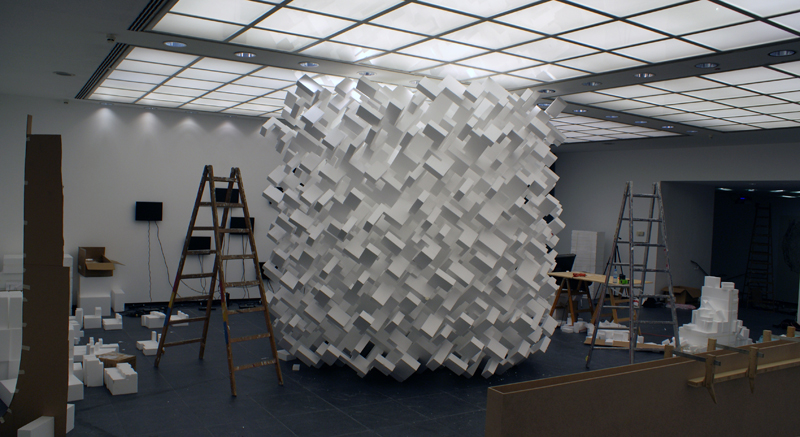
Fat Bastard: end of sixth day of installation (2010). 
(Return to Part 7.5)
In his book, What Technology Wants, Kevin Kelly explains that a very common error made with almost all new technologies is "to imagine the new thing doing an old job better." The old, premodern, job of art, as an expression of top down authority, was misattributed to modernity by the Modernists.

Monday, December 6, 2010

Art Then Technology (Part 1): I Want To Be A Verb

Fat Bastard (2010), 11’ X 14’ X 14’

My favorite essay by my favorite artist is Robert Smithson’s 1969 Towards The Development of an Air Terminal Site. It’s not a piece that gets a lot of attention from academics or other artists - so part of my affection for it is that I have it somewhat to myself. It is a great, if sprawling, totally confounding, think piece loosely dealing with the intersection of art and technology. In it Smithson proposes looking at the relationship of an air terminal and the aircraft it hangs below in order to “find a whole new sets of values.” The existing set of values attached to high technology of flight he wanted to see past were “a rationalism that supposes truths--such as nature, progress, and speed.” In the same essay he suggest looking at a dam construction site as “an abstract work of art that vanishes as it develops.” Each moment, he suggests, is a “discrete stage” in a series. But Smithson admits that that functionless wall will cease being a work of art when it becomes "a utility." (Incidentally, it is the essay that sparked this blog - in it Smithson also uncannily predicts the faceted aerodynamics of the stealth bomber and the crystalline shapes of the space ships in Star Wars. It is a bad-ass piece of writing.)

Tuesday, August 3, 2010

The Architecture of Inception: Combat Archaeologies


Combat Archaeology


In a discussion of the methods he laid out in his book, The Archaeology of Knowledge, the French philosopher Michel Foucault admitted:


A nightmare has haunted me me since my childhood: I am looking at a text that I can't read, or only a tiny part of it is decipherable. I pretend to read it, aware that I am inventing; then suddenly the text is completely scrambled, I can no longer read anything or even invent it, my throat tightens and I wake up. 
I can't read in my dreams, words are always garbled, but I don't experience the confusion as a nightmare - it is always a fun discovery that makes me aware that I am sleeping. But then, Foucault was a writer, and I'm a sculptor. Tellingly my most crushing childhood nightmare was nothing more than disassociated shapes and colors. The horror came because there was something monstrous about the scale of things - as if you were to look down at your fingernail and suddenly realize it was a mile thick. Christopher Nolan's Inception seems to occupy the territory that precedes the horror (both mine and Foucault's). Nolan is using the logic of dreams to build his narrative, more than their expressions. In the film dreams are deeply constructed spaces - they are architecture. The architecture of the film is stacked and collapsed layers of logic.