Showing posts with label Progress. Show all posts
Thursday, February 3, 2011
Art Then Technology (Part 7): Companionate Authority
(Return to Part 6)
I began thinking of Art as authority sometime after I moved to New York, and only began thinking of authority as a technology since reading Kevin Kelly's New book What Technology Wants. Kelly's conception of technology is far broader than most. In addition to our gadgets and industries he includes the entire universe of man-made things; everything from literature and art to abstractions like the rule of law and the scientific method. Kelly makes the case for technological (in its broad sense) Progress (with a capital "P") as inevitable. He largely avoids the cliches of his Modernist predecessors ("Better living through chemistry," "One word: Plastics," etc.), but he does unpack and and dust off the old narrative of "Every man is a King." Kelly tells how he and his daughter counted all the objects in their home (10,000 objects) and compares that with the average number of objects in homes in the developing world (127 objects), contrasting those numbers with King Henry the VIII (18,000 objects), colonial Americans and other historically representative common folk (40-75 objects). Kelly champions technological Progress in terms of Freedom, that innovation brings an increase in the number of choices we have available to us.
Monday, December 6, 2010
Art Then Technology (Part 1): I Want To Be A Verb
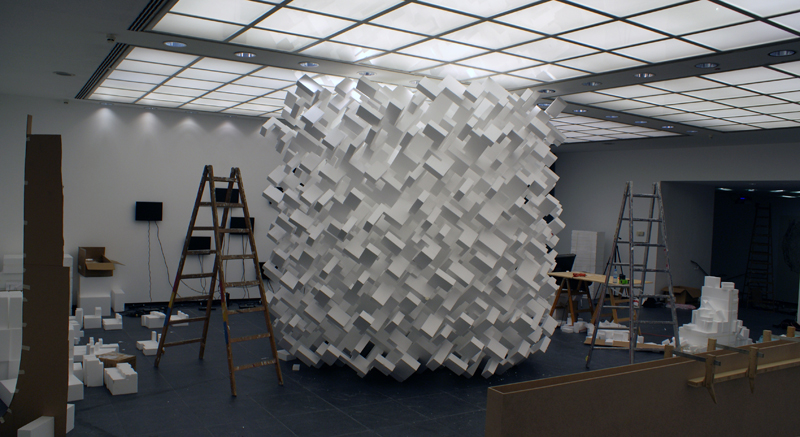
Fat Bastard (2010), 11’ X 14’ X 14’
My favorite essay by my favorite artist is Robert Smithson’s 1969 Towards The Development of an Air Terminal Site. It’s not a piece that gets a lot of attention from academics or other artists - so part of my affection for it is that I have it somewhat to myself. It is a great, if sprawling, totally confounding, think piece loosely dealing with the intersection of art and technology. In it Smithson proposes looking at the relationship of an air terminal and the aircraft it hangs below in order to “find a whole new sets of values.” The existing set of values attached to high technology of flight he wanted to see past were “a rationalism that supposes truths--such as nature, progress, and speed.” In the same essay he suggest looking at a dam construction site as “an abstract work of art that vanishes as it develops.” Each moment, he suggests, is a “discrete stage” in a series. But Smithson admits that that functionless wall will cease being a work of art when it becomes "a utility." (Incidentally, it is the essay that sparked this blog - in it Smithson also uncannily predicts the faceted aerodynamics of the stealth bomber and the crystalline shapes of the space ships in Star Wars. It is a bad-ass piece of writing.)
Subscribe to:
Posts (Atom)

