Friday, February 25, 2011

Watching the Watchmen

Charlie Sheen in Two and A Half Men: The crowd watching Christian Marclay's Clock.

I have written on the subject of criticism and popularity before, so when I got in a short dust up with Tyler Green on Twitter, I was going to let the subject drop - but I am like a dog with a bone. If you follow this LINK you will find a cut and paste of Tyler Green’s recent review of Christian Marclay’s The Clock with a few edits. It was assembled by Steve Mesler who usually blogs about making art for Huffington Post. Steve sent me this after my short back and forth with Green. Steve, who is in Savana interviewing Marina Abramovic today, took the “Find and Replace” function in google documents, replacing Christian’s name for Abramovic's and The Clock for The Artist is Present. Add in a couple of liberties with the narrative and what you have is a review for any popular show the art world has ever, or might ever mount. I asked Steve if I could link to his joke because it shows exactly why I found Green's review so disappointing. In a review of what I felt was a complex piece of durational art, about time, Green chose to write a formulaic review complaining against formula. Green Accused Marclay of being tired, but used the most tired of all art world cliches: he chose to sneer at the crowds of us gullible to want to see the work at all.

Thursday, February 17, 2011

Who's Afraid of the dark? Not Christian Marclay.

Richard Serra, Hand Catching Lead (196?); The installation of Christian Marclay, 24 Hour Clock (2010)

Christian Marclay's 24 hour video, Clock is the most perfect gallery installation of video I've ever seen. In the same way that I am not a cat person, but I love particular cats, I am guardedly pessimistic when it comes to video installations. I have not been to a show, of any kind, that is this good in years. So far I have spent 6 hours watching (easily five hours more than I have ever spent with any other single video installation) and am looking forward to catching as much as I can before the show comes down this weekend. (I am fantasizing about having Clock installed in my house.) This is not just because I enjoy the video itself (although I very much do); it is because this video is installed the way all video art should be installed: three rows of four overstuffed light grey sofas, that not only allow you to lean back and watch; because they aren't black, one can easily move about and find a seat. Genius - or at least relative genius, because every other video installation I have ever been in has been so willfully stupid. It is telling that it took a 24 hour video to force a gallery to install video in a way in which it can be watched for more than just a few minutes.

Friday, February 11, 2011

MEMORIES OF “MEMORIES OF THE GORE ADMINISTRATION”

POTUS, Alt Gore's State of the Union Address; alternate Earth's NYC skyline on Fringe.
After reading "Memories of the Gore Administration" in the Dec 13th issue of New York Magazine, I asked Kurt Andersen via Twitter how the piece was constructed (it was done as an exquisite corpse), and tweeted that it would be interesting to read about how he and Glenn Beck ended up writing an alternate history of Al Gore's presidency together. Andersen put me in touch with Christopher Bonanos, who generously agreed to write a guest post about editing the thing together. Tomer Hanuka, who illustrated the piece for New York, agreed to let me use his images and even supplied me with two additional sketches that haven't been posted online before.
Around July of 2010, Adam Moss--who runs New York magazine, where I work as an editor--asked his team to start coming up with potential cover-story ideas for the fall. I’m not sure how I started thinking about tenth anniversaries, but I tend toward stories of a historical nature anyway, and I had just written a piece about Ground Zero, which put me in mind of 2001/2011. Maybe it was just all the midterm-election ramp-up coverage on cable news. In any case, I saw November on the calendar, and realized that the disputed Bush/Gore election was going to be ten years in the past.

Thursday, February 3, 2011

Art Then Technology (Part 7): Companionate Authority

Fat Bastard: end of fifth day of installation (2010).
(Return to Part 6)
I began thinking of Art as authority sometime after I moved to New York, and only began thinking of authority as a technology since reading Kevin Kelly's New book What Technology Wants. Kelly's conception of technology is far broader than most. In addition to our gadgets and industries he includes the entire universe of man-made things; everything from literature and art to abstractions like the rule of law and the scientific method. Kelly makes the case for technological (in its broad sense) Progress (with a capital "P") as inevitable. He largely avoids the cliches of his Modernist predecessors ("Better living through chemistry," "One word: Plastics," etc.), but he does unpack and and dust off the old narrative of "Every man is a King." Kelly tells how he and his daughter counted all the objects in their home (10,000 objects) and compares that with the average number of objects in homes in the developing world (127 objects), contrasting those numbers with King Henry the VIII (18,000 objects), colonial Americans and other historically representative common folk (40-75 objects). Kelly champions technological Progress in terms of Freedom, that innovation brings an increase in the number of choices we have available to us.

Sunday, January 9, 2011

Michael Moore is the Lamest of All Jedi and Sarah Palin is nothing more than a Sith Lackey

A gaggle of lame Jedi, including the lamest of them all, Michael Moore.
 
You cannot live in America without having lots of friends on the far Right of the political spectrum. For those of you wringing your hands in Europe about the rise of the Right, you have no idea what Right Wing actually means. Anti-immigration fear-mongering is kid stuff - little more than distracting hand waving. Europe hardly ever gets past that hand waving. Here in the US, we get to see what is behind the waving hand. For us the the Right means no social safety net beyond the world's highest rate of incarceration

Friday, January 7, 2011

Art Then Technology (Part 6): Authority is a Technology

Fat Bastard: end of fourth day of installation.
(Return to Part 5)
I hate the canard about abstract art acting as a 'visual pause' in the otherwise hectic environment of consumer capitalism, I always have. The part I dislike is the justification of the 'pause', it's such weak tea. I am not a huge fan of either capitalism or consumerism, but I love the spectacle of Times Square and the squirrely density of consumer goods at my corner bodega. I enjoy the density of imagery and noise, and the press of the crowd; that has not always been the case however. Not long after I arrived in New York I took refuge in a Dan Flavin retrospective. 

Friday, December 31, 2010

Witness the Last Man

Francis vs Bob

2011 is to the future what twenty-two is to adolescence. In the roll call of millennial benchmarks 1999 was thirteen,  the year we finally become teenagers (and we could finally party like it was Prince had promised us we would). Stanley Kubrick made 2001 a far more adult benchmark, it was more akin to a sixteenth birthday, we got our drivers licence, but we were becoming aware that this future/adult thing was happening right now. 2008 turned out to be our like an eighteen,  it was the year we voted (yes we can). 2010 was the year Aurthur C lark promised we would make contact, it was our twenty-one, the final benchmark of our transition to future-present adulthood, and we all needed a drink. 2011 is our twenty-two because that is the first birthday in which there is no great benchmark to look forward to. It's first year of the rest of your life. Welcome to the future, the end of benchmarks, the end of history. It sounds grim, but it actually isn't, it a really good thing.

Monday, December 27, 2010

Art Then Technology (Part 5): Abstract Art Is A Technology.

Fat Bastard: end of third day of installation.
(Return to Part 4)
As a participant in an exhibition of abstract 'generative' art called abstrakt - Abstrakt, I spent nine days installing, and had a lot of time to think about the work of the other artists in the show, most of whom used or addressed the crumbling edge of digital technology, and almost all of whom evoked for me the flatfooted logic of the last great wave of abstract art, 1960s era minimalism. My work is sometimes describes as post-minimalist. I like to describe it as post-Star Wars-minimalism, but not because it's high-tech. My art is not-at-all-crumbling edge; I use no advanced technology, my design and fabrication is entirely analog, but by the time I became aware of abstraction, Modernism had been recast as the Deathstar and destroyed. Abstract artist of my generation are "late-adopters." Late adopter is a term usually reserved for technologies. My decision to take up abstraction in the mid-1990s was because abstraction is not a style, that the difference between abstract art and earlier art is not a difference in quality, it is a difference in kind. But it has only been as I've been thinking about exactly what technology is that it occurred to me that the difference is the difference between a very old technology and a relatively new one.

Thursday, December 9, 2010

Art Then Technology (Part 4): Sympathetic Summary

Fat Bastard: end of second day of installation.
(Return to Part 3)

It occurred to me as I was talking to a friend about this series of posts that I had failed to explain how I knew about Kevin Kelly and why I knew to pick up What Technology Wants. I first became aware of Kelly when he wrote a very positive piece about my essay, Star Wars: A New Heap, a couple years ago (that didn't suck at all). Since then I have become addicted to the Longnow seminar series he curates (sorry Joanne) with Stewart Brand. So I had a good sense of who Kelly's intellectual footprint before I picked up his latest book. Kelly is unabashedly pro science and technology. It is a position I find attractive but also makes me squirm. I am at once a believer in the positive long term role of science and technology (I agree with Kelly they give us choices), but deeply ambivalent when it comes to the damage being done by the consumer capitalist economy. I believe terms for contemporary conditions that begin with the "post" or "late" are premature at best, deceptive at worst.

Wednesday, December 8, 2010

Art Then Technology (Part 3): Hitchhiking in Flatland

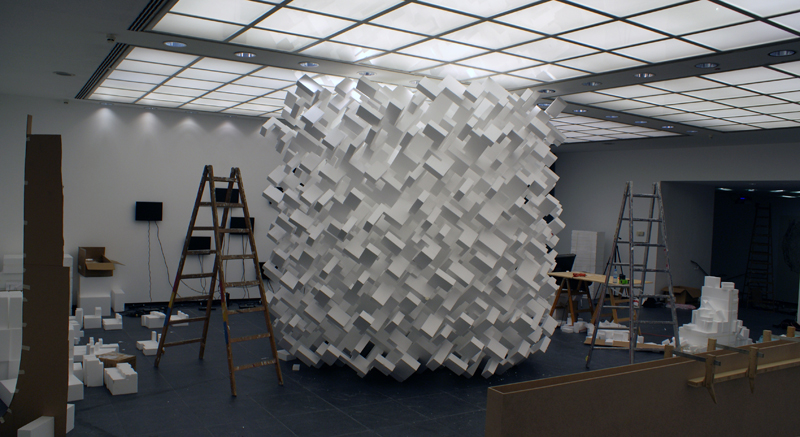
Fat Bastard: end of first day of installation (2010)
(Return to Part 2)

When I was 16 I hitchhiked from Chicago to New York during what turned out to be the worst cold-snap to hit the East Coast in 90 years. That sucked. It was an ill advised decision, made on the spur of the moment, by a much different version of myself (he was a bit prettier). In addition to returning home with walking pneumonia, I had developed a very restless thumb. Perhaps because I started riding the Chicago mass transit system in middle school (which was very near Cabrini Greene), traveling among strangers in circumstances most people would find dangerous was old hat. What I discovered on that first trip was that hitchhiking was safer than the 1980s era El. Add to that I was a  bit of a risk taker as a boy. My mother has told me she was relieved that at sixteen I showed so little interest in getting a drivers licence, but she would have much preferred I had done that instead of hitching. I think hitching was a safer choice for me. As it is I didn't get my licence until I was 24. I hitchhiked instead. The reason had nothing to do with risk or driving my ma nuts, I kept at it because I really liked the people I met.

Tuesday, December 7, 2010

Art Then Technology (Part 2): Turn Off, Tune Out, Drop Back.

Fat Bastard: Initial Condition (three large polystyrene blocks arranged symmetrically)
(Return to Part 1
The relationship between technology and the contemporary art world is a fraught one. While genuine excitement surround projects that use powerful computer programs or novel CNC fabrication techniques and art history can be unrolled as a series of technologies, most historians, curators, collectors and artists are best described as late-adopters, if not out right non-adopters. I myself am a somewhat imperfect example (it's complicated). I began my career by apprenticing myself to a Luddite. The system of master/apprentice is itself a relic of the Middle Ages, it was abandon by the mainstream as form of art education way before the guy I apprenticed to was born - but he was a Luddite, so I lucked out. It turned out to be an ideal pedagogical format for me, not only to learn lost wax plaster investment bronze casting-- a technology that is over 5000 years old--but also a chance to get my bearings in the world. When I began my apprenticeship I was a wastrel truant case from Chicago. I had just barely graduated high-school with a very low D grade point average, that had its beginnings in primary school. College was not an option, and even if it had been, it probably would have been a waste of time and money. As unconventional as it was, my apprenticeship was my first taste of academic success of any kind (I wish I could have started it at 9 instead of 19).

Monday, December 6, 2010

Art Then Technology (Part 1): I Want To Be A Verb

Fat Bastard (2010), 11’ X 14’ X 14’

My favorite essay by my favorite artist is Robert Smithson’s 1969 Towards The Development of an Air Terminal Site. It’s not a piece that gets a lot of attention from academics or other artists - so part of my affection for it is that I have it somewhat to myself. It is a great, if sprawling, totally confounding, think piece loosely dealing with the intersection of art and technology. In it Smithson proposes looking at the relationship of an air terminal and the aircraft it hangs below in order to “find a whole new sets of values.” The existing set of values attached to high technology of flight he wanted to see past were “a rationalism that supposes truths--such as nature, progress, and speed.” In the same essay he suggest looking at a dam construction site as “an abstract work of art that vanishes as it develops.” Each moment, he suggests, is a “discrete stage” in a series. But Smithson admits that that functionless wall will cease being a work of art when it becomes "a utility." (Incidentally, it is the essay that sparked this blog - in it Smithson also uncannily predicts the faceted aerodynamics of the stealth bomber and the crystalline shapes of the space ships in Star Wars. It is a bad-ass piece of writing.)