Monday, June 20, 2011

White Walls, Soft Wear (Part 8)

Whitey on the Moon, Neil Armstrong, looking exhausted; Gil Scott-Heron, mad as hell.
(Return to Part 7)
Had NASA engineers been less enamored with AX hard suits, the most glamorous failure of it's military-industrial culture of design/production, and more conscious instead of the success born out of that failure, the soft complex layering of hand-sewn textiles actually worn on the moon by Apollo astronauts, perhaps when it's systems engineers turned to urbanism they may have approached the "problem" of the city with a bit more humility and flexibility. But I doubt it. The engineer-urbanists were primed by decades of wrong-headed idealism espoused by authorities like Lewis Mumford to "solve" the blight of "metropolitan centralization," and "remedy... increasing congestion" of cities like London and the "dingy railroad metropolis of Chicago" by turning them into country estates.

Wednesday, June 15, 2011

White Walls, Crime Waves (Part 7)

Peter Seville, New Order, Substance (1988); Matrix Code (1999)
The art blogger, Hrag Vartanian, pointed out at a party recently that there is a disconnect between the whiteness fashioned for the Apollo missions and the whiteness of hi-tech today. For a time the look of the future was black diode screens with carbled green fonts. He is right, whiteness, as a marker of hi-tech  cool, seems to have disappeared sometime in the late 70s and only reappeared recently.

Monday, June 13, 2011

White Walls, Hard Wear (Part 6)

Parthenon Frieze; Telephone Switchboard
When Corbusier wrote in 1923 that, "Architecture can be found in the telephone and the Parthenon," he was not thinking of whiteness as part of an inheritance of immutable visual meaning like Albert Speers and other devils who dreamed of white neoclassical cities, he was thinking of whiteness as a way to express a modern system. In his book, White Walls, Designer Dresses, Mark Wigley observes:
The Parthenon has to be thought of as a system of communication like the telephone. And the telephone is has to be thought of as a means of production of space like the Parthenon. The telephone, like all systems of communication, defines a new spatiality and can be inhabited... Like the coat of paint, the telephone is a form of clothing that can be occupied, but not by the preexisting culture.

Friday, May 27, 2011

Cathy de Monchaux is a Jedi

Padmé Amidala looking uninviting; Cathy de Monchaux, Red (1999)

The other day I was thinking about a sculptor who's work had made an impression on me in the 1990s. I've tried to remember her name a number of times over the years, but because she used a lot of S&M imagery in her art, without her name, I couldn't think of any way to google for her without wading through hundreds of pages of violent porn (not my thing).

Thursday, May 26, 2011

White Walls, Foundational Garments (Part 5)

The look of control: Alen Shepard suiting up (1959); Offutt ICBM Air Base Control Room (1957)
(Return to Part 4)
In the postwar year Émigré Modernist architects abandon the exterior whitewash that they had made a requirement on their first collaborative housing estate, because it had aged poorly. In an America, the lines between corporate, government, military, and academic cultures had begun to blur. It was an America that meant business. These were the first Cold Warriors. For security reasons military officers dressed in identical uniforms of dark business suits and crisp white shirts and their company men peers. A uniform so ubiquitous in the American corporate business world, in a recent video, Management Science expert Barry Franz recalls the strangeness of meeting an IBMer dressed in a brown suit. A key element of the look these new organization men aspired to was the Playtex girdle.

Monday, May 23, 2011

White Walls, Tighty-Whities (Part 4)

Charlie's Angels (2000); Bauhaus
The architecture theorist Mark Wigley argues that architects designing white buildings today, like Richard Meier, are reacting to an illusion of whiteness that never existed in the white housing estate built above Stuttgart in 1927. White exteriors and flat roofs the only two conditions for the architects participating in the showcase. The lineup included Le Corbusier, Walter Gropius, and Ludwig Mies van der Rohe, all of whom would go on to be leading lights of the modernist movement. Wigley fails to explain what photography might have meant to the original architects before they were leading light. He is however very clear about what whiteness meant to them: "the central role of whiteness in the extended history of of the concept of cleanness. Modern architecture joins the doctors white coat, the white tiles of the bathroom, the white walls of the hospital, and so on." Wigley believes that just as the buildings were not as white as they look in photographs, the whitewash was less about actual cleanness and more a mater of "a certain look of cleanness. Or more precisely, a cleansing of the look, a hygiene of vision itself."

Saturday, May 21, 2011

White Walls, Double Negative (Part 3)

The hand of the shooter; Jacob Riis, Scrub Woman (1892); Unforgiven (1992)
(Part 2)
The post War embrace of the NEW was a very real need to drive out all shadows, to forever wipe away the disorder and corruption of the old world that had produced the Great Depression and the two world wars. The Modernists promised to make an orderly clean world. For a time they were able to deliver on that promise - but in no way could they do it if they had stuck with a program of white exteriors as they did in Wiessenhofsiedlung.

Friday, May 20, 2011

White Walls, Elgin Marbles (Part 2)

Full Metal Jacket (1987); Parthenon (438 BCE)
(Part 1)

The eighteenth century archaeologist and art historian Johann Joachim Winckelmann was aware that the Parthenon had been painted flamboyant gaudy colors but chose to ignore the ugly truth: "The whiter the body is, the more beautiful it is as well," he wrote. "Color contributes to beauty, but it is not beauty. Color should have a minor part in the consideration of beauty, because it is not [color] but structure that constitutes its essence." That is creepy Speerian stuff, and for sure, the rhetoric of white is larded with stuff like that. In his book, White Walls, Designer Dresses, Mark Wigley writes that "The white wall is taken for granted. At most a generations of commentators have referred to it in passing as 'neutral,' 'pure,' 'silent,' 'plain,' 'blank,' 'ground,' 'essential,' 'stark,' and so on."

Thursday, May 19, 2011

White Walls, Saturn Rockets (Part 1)

Sigourney Weaver, Aliens (1979); Otto Apel, Former American Embassy, Frankfurt Germany (1955)

A day or two before Apple announced they would release the long delayed white iPhone 4 my friend Joanne McNeil wrote me because she was working on a piece about the concern and confusion elicited in strangers by cracked face of her black iPhone. The cracks had not effected the phone's interface and because Joanne had liked the way her cracked screen made her phone easy to identify from other's perfect, and perfectly identical iPhones, she had decided not to have the cracks repaired. But the imperfection was troubling to those around her. Strangers, afraid she would cut herself would urge her to have the face replaced. Joanne would explain that the screen was still smooth and worked fine, but still the anxiety (in others) remained. Even after she explained it's personalizing utility, her choice not to repair the imperfection flummoxed smartphone Samaritans. Joanne's phone is black but thinking about perfection lead her to wonder about the "hi-tech look" of white. She was wondering if I had any thoughts about where/when that all began.

Thursday, May 5, 2011

Art Then Technology (Part 8): Modernism Is Not Modernity

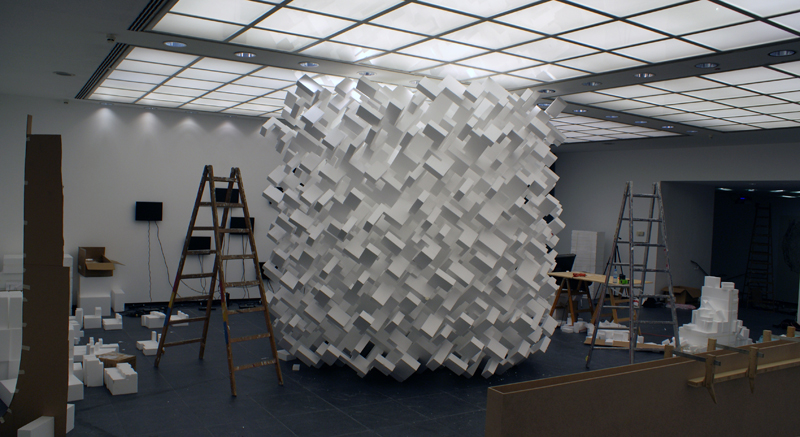
Fat Bastard: end of sixth day of installation (2010). 
(Return to Part 7.5)
In his book, What Technology Wants, Kevin Kelly explains that a very common error made with almost all new technologies is "to imagine the new thing doing an old job better." The old, premodern, job of art, as an expression of top down authority, was misattributed to modernity by the Modernists.

Monday, May 2, 2011

Art Then Technology (Part7.5): Medium is not the Message

US Dollar; Johannes Adam Simon Oertel, Pulling Down the Statue of King George III, (1859)
(Return to Part 7)
When I introduce myself as a sculptor, the most common first question people to ask is what “medium” I work in. I do my best to answer, but I am always a bit at a loss. I understand what people want to hear, but not what it is they want to know. I'm aware that people are usually not just being polite, that they making good spirited attempts to show an interest in an unusual occupation. But asking a sculptor about their medium is no more meaningful than asking a banker what currency they truck - you could do it, but even on the off chance you met a single-currency banker, what would you learn? My own experience, as the object of that question, is you don't learn much from the answer.

Wednesday, April 20, 2011

Bar Bets Are Dangerous: A Theory.

The author happily washing down a serving of crow and theorizing with a little Kittler at my elbow.

The folks at Hyperallergic decided the debate between Michelle Vaughan and I, and I lost. I'm OK with that. The point of this blog is that theory and history and art should be fun, that art has no borders that need to be protected, but that what is at stake is what we believe about ourselves and out times, and those beliefs should be defended (if not to the death, at least until dinner time, and it's time for dinner). The debate with Michelle has been all that. Best of all, I have enjoyed reading the comments, emails and Twitter-snark that surrounded the back and forth. 

A long while back in a comment thread about a not totally unrelated idea some calling themselves "bert" and Joshua Noble suggested I read Friedrich Kittler's Optical Media, it arrived just in time to comfort me in my defeat. I haven't read far, but here is what I was thinking about when I learned that I would have to start planning a meal for my friends:
Besides the old ritualistic meaning of "carnival progression," the word "theory" - the primary word of Greek Philosophers - meant nothing other than "look," "observe," "a feast for the eyes," or even "pageantry," and first assumed the meaning of "a scholarly teaching"after or through Plato. 
Michelle wrote to tell me it was a "win-win," and I can't agree more. Congratulations Michelle and Bon Ap'!