Laocoön and His Sons (160-20 BCE), Frank Stella, Newburgh (1995)
As counter-intuitive as it is to think of sculpture as painting, that is in fact the steady state; the status quo, not the exception. In her book, Passages in Modern Sculpture, Rosalind Krauss quotes the the 19thCentury theorist Adolf von Hildebrand, who writes:
All separate judgements of depth enter into a unitary, all-inclusive judgement of depth. So that ultimately the entire richness of a figure's form stands before us as a backward continuation of one simple plane, whenever this is not the case the unitary pictorial effect of the figure is lost.
Frank Stella, Hyena Stomp (1962), Robert Smithson, Spiral Jetty (1970)
Barnet Newman's quip that, "sculpture is what you bump into when you back up to see a painting,” has become a cliche no self respecting art historian would quote. So it's a curious pleasure to find it in Rosalind Krauss's essay, Sculpture in the Expanded Field. (It's like coming across a knock knock joke in a Walter Benjamin essay.) Like all humor, Newman's joke is funny because it is a little cruel, and it is cruel because there's some truth to it (one of my pieces was damaged that way once - my friends all laughed). As a sculptor it is painful to admit this, but by all accounts, for most of history, painting has driven art. That’s why we discuss the death of painting, and (almost) never the death of sculpture. The harsh truth is, no one much cares if sculpture dies because sculpture is thought of as a kind of painting; a parasitic twin carved in stone.
Comic book burning bastards; John Byrne, Galactus (FF #257)
Jack Kirby was an early master of a bastard genre. Kirby is the artist who gave us The Fantastic Four, The Hulk, Captain America, and The X-Men. His art is brash. He took the limitations of cheap printing and even cheaper paper and stretched them into an epic career, leaving behind enough material to be explored by generations of American artists. Kirby combined acid colors with great heavy bands of black to stunning effect. All the angst, agitation and action of modernism are on display in Kirby’s art. His comics combine strange Freudian undertones of fetish, with the mourning alienation and wild-man machismo of the lost generation. The worlds he imagined are impenetrable chrome and anodized masses of cylinders, cubes, and spheres. Figures are likewise massively built in a way alien to most comics today – these guys weren’t carrot shaped Fabios, they were great garbage can men with arms and legs like tree trunks sheathed in ringed metallic skins of purple and green. Great stuff.
Until recently I hadn't given much thought to how morbid my imagination is. I think it is the nature of my profession. Sculpture is ALL about death. My studio is next to the rear entrance of the Greenwood Cemetery and in nice weather I like to walk to the grounds. For anyone who has never visited Greenwood, it was designed by Fredrick Law Olmsted, the same landscape designer that designed Central Park. One of the artist Robert Smithson best essays is on Olmsted's theories of the picturesque. I believe the cemetery is hands down New York's most beautiful green space, it is also one of its largest (its HUGE) and least visited, which it too bad.
The grounds are peppered with a labyrinth of mortuary cul-de-sacs. Instead of McMansions on hills however, these are dug out fjord-like turn-arounds with hilariously grand stone entrances built in to steep hillsides. They are like a mash up of the Acropolis and a Hobbit village.
The trails through the cemetery feel like a wilderness, not at all a part of New York City. They are covered in years of accumulated pine needles and miniscule pinecones. Best of all, the place is a dogpatch of weird 19th century architecture and statuary. There are at least a half dozen pyramids - in Brooklyn. They are not Great Pyramid big, but they are big. One is at least two stories tall (belonging to the Hoyts or the Schermerhorns, I can't remember which) and made of black polished stone - CRAZY. There are little cathedrals, fully realized in the round, the way a full size cathedral never could be. The the Civil War dead are buried there - there is a strange monument to them on top of a hill. Even if I didn't have a soft spot for a clean quiet place, this place is has some of New York's best architecture and art rotting away for all to see.
Rosalind Krauss’s essay, Sculpture in the Expanded Field, is not only a corner stone of critical theory, it is a very important touchpoint for me personally. (I explained my attachment in a recent post about her Klein group diagram & Star Wars.) Written over thirty years ago (Krauss's essay, not my post), it remains one of the best pieces of writing about contemporary sculpture - but like the great majority of top tier art writing it can make for dense and difficult reading. I have spent the last year and a half or so combing through the essay and it was only recently, as I prepared my post for HyperAllergic that I dug up what I think is the most important element of Krauss's argument.
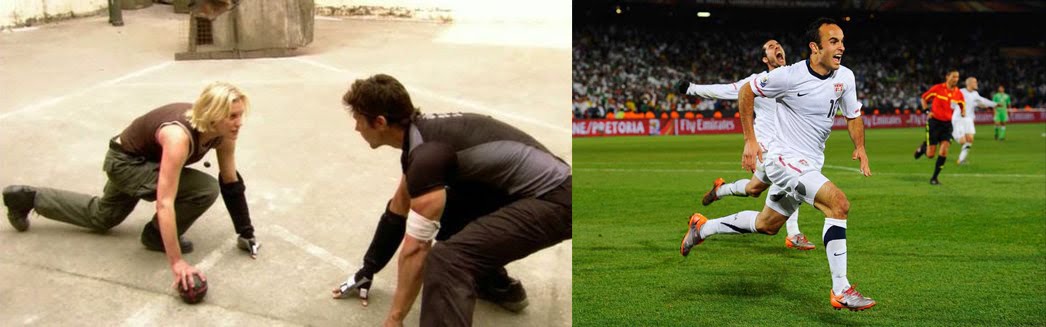
Battlestar Galactica's overly complex sport, Pyramid, cannot compete with the real world simplicity of Soccer.
The two great blind spots in scifi are sports and religion. There are a few cases where made up games work - I seem to remember the contests in Tron were pretty great, but they were extremely simple. Maybe that’s the trick, if your going to make something up out of whole cloth, less is more. The Force was a solid and sketchy exception to the rule on the religious side. Battlestar Galactica was the worst offender on both counts. "Pyramid" sucked (SO BAD!), and while the set up was really promising - monotheistic robots vs polytheistic humans, the opportunity was squandered. The show degenerated into new-age-ish pap (even new-agers have more depth then that show). Both sports and religion subtracted from that show, but that is almost always the case.
What got me thinking about this is I spent the last few days watching the World Cup with my very patient friend's Michelle Vaughan & Felix Salmon. I am not a sports fan at all. Felix & Michelle were really great at explaining all the ins and outs of the rules (Felix is a Brit, Michelle is married to one), the dynamics of the teams, the heats (or whatever) and the other various what what (only about 10% of what I was told could have possibly been absorbed by my wimpy non-sport brain).
A year and a half ago, about the time I had finished writing the essay Star Wars: A New Heapfor Triple Canopy, I was killing time on a long flight and I started doodling an idea: could I rework the Klein group diagram from Rosalind Krauss's essay, Sculpture in the Expanded Field, to describe the visual program of Star Wars? For those of you not familiar with Krauss, in the logic of my Primer, she is Princess Leia to Robert Smithson's Luke Skywalker and Michael Fried's Darth Vader. If you are unfamiliar with her essay on the Expanded Field you can check it out as a PDF here.
For some time my 11 year old nephew, Sebastian Mesler, has been after me to work on a Star Wars Lego animation with him, but my heart isn't in it. Last night we struck a compromise and made a Lego Marina Abramović - The Artist is Present - diorama as her performance art marathon was coming to an end.
I'm posting our work as I am aware that I haven't posted in a while. I haven't been idle. Inspired by Abramović's retrospective and Antony Gormley's outdoor installation Event Horizon I am working on a series of posts about Rosalind Krauss's 1979 essay, Sculpture in the Expanded Field. More to come...
..but before I get into that, our Lego/Art geek mash up wouldn't be complete without a show of tears.
I cannot figure out how to embed video any larger than this, I suggest watching this full screen.
Above is a primer that explains American Post War abstract art in terms of Star Wars (the two line up eerily well). This is part of the video that will be screened at the Philoctetes Center. I heard the score for this the first time today. I could not be more pleased. Hopefully Luke will post it as part of hisYear In MP3sproject, if and when he does I will link to it so we can all listen to it uncut.
UPDATE:
The screening went really well, and there was a fun question and answer about the project afterwards. Hyperalergic posted a very nice piece about the screening by Zach Cohen HERE.
I cannot figure out how to embed video any larger than this, I suggest watching this full screen.
This is an a "fair use valentine" created by the sound and video artist R. Luke DuBois. When I make my sequel to The Matrix (The Matrices - its going to be so cool) this is the imagery I want to use to replace the green code. In the meantime Luke is composing a score for my current video project, the episodic artist commentary Star Wars & Modernism.
On May 20th the composer R. Luke DuBois and the writer Colby Chamberlain will join me to discuss and screen three episodes (about 45 minutes of video) of an artist commentary I began working on this past fall. It’s a free event open to the public (details above, and here). The clip embedded above is an introduction that explains the project. It is a work-in-progress that will round out to be 14 or so episodes, each focusing on ten or so minutes of the original 1977 Star Wars film (A New Hope). I recently began collaborating with DuBois, who is providing an original score for the commentary. He explains his contribution to the project much better than I could ever hope to:
The soundtrack is constructed using the harmonies and melodies of John Williams’ orchestral score for Star Wars: A New Hope, mutated with the rhythms and keyboard performance practice of Philip Glass in his minimalist compositions from the 1970s.
The music is algorithmically constructed and takes the conceit of the mash-up into the realm of musical, rather than sonic, information space. In the mash-up, an audio artist takes multiple popular recordings and samples them both, overlaying them to create a third, hybrid track. In the music for this film, I decided to create a mash-up based not on sampling the recordings of John Williams and Philip Glass, but by subjecting their music to computer analysis to deconstruct the essential musical vocabulary of both composers so that I could blend them seamlessly into a new body of music.
The result is an algorithmic, aleatoric work for keyboard that evokes Star Wars without ever sampling it, sounds like Glass without sampling any, and perfectly suits the tone and subject matter of John's commentary.
The Sith are the bad guys in Star Wars. Darth Vader and the Emperor are Sith Lords. They are the Yin or “dark side” to the Jedi Yang.
What does the term Sith mean as it is used on this blog?
Beyond their place in the fictional universe of Star Wars, the Sith are a narrative element of a film made by a particular group of people in a particular time and place. Therefore the Sith have a very real social and political context. And it is this very real world idea that I am referring to in this blog:
Lucas and his crew were young Americans working together at the end of the Vietnam War and in the shadow of Watergate. In the parlance of that era’s youth, the Sith are “The Man.” They stand in for the corrupt authorities of the day as seen by the young people of the day. Lucas describes them as “Nixonian gangsters.”
And like Nixon, the Sith perfectly represent a particular strain of American authority: Cold Warriors. Not just the violence and paranoia of America’s anti-communist foreign policy, but their repressive and absolutist domestic policies: “Are you now, or have you ever been a member of the communist party?”
Even the world building efforts of the cold warriors were perfectly embodied by Lucas and his crew. The top-down Utopian art, architecture and urbanism of the Cold Warriors were elegantly re-imaged as the Deathstar.
The Sith are characterized by the same traits that identify the Cold Warriors: they want control; they use a fear of chaos to squash any and all dissent. Their solutions are over simplified and deny the importance of disorder and spontaneity.
In the realm of urban planning Robert Moses was a Sith.
Are Sith creatures of the 1960's and 1970's?
No. The decade long rule of NeoCons was an unmitigated Sith disaster and puristic and absolutist mindsets survive in architecture, art and urbanism under every imaginable rubric.
What does it mean when I use the term Jedi on this blog?
Just as the Sith have a real world context (see above FAQ) so do the Jedi. But just because I believe the Sith were inspired Cold Warrior anti-communists and Modernists, I do not mean to say that the Jedi were Post-Modernists and communists.